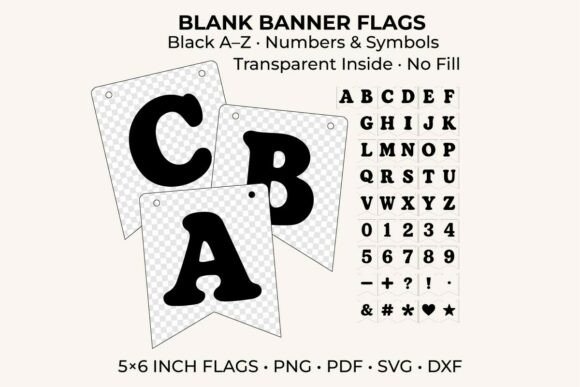
Blank Banner Letters A–Z 0–9 Set
A Designer’s First Look: Clean, Flexible, and Quietly Confident
When I opened the Blank Banner Letters A–Z 0–9 Set, my first thought wasn’t “cute” or “trendy”—it was “usable.” That’s rare. These aren’t fussy script letters or overly stylized monograms. They’re simple banner-shaped flags, each with a bold black letter centered over a transparent inner background. No drop shadows, no gradients, no decorative flourishes—just clarity and intention. As an embroidery designer who’s stitched everything from nursery wall art to boutique aprons, I immediately saw where this set fits: in projects where legibility matters more than ornamentation. Think baby onesies with names, tote bags for farmers’ markets, or kitchen towels for wedding gifts. The mood is friendly but grounded—like a well-cut font you’d trust on a small-batch product label.
How It Stitches Up: Real Projects, Real Fabric Behavior
I tested the Blank Banner Letters A–Z 0–9 Set across three real-world scenarios: a cotton twill tote bag (for a local coffee roaster), a soft organic cotton baby onesie, and a woven tea towel destined for a holiday craft fair. On the tote, the banners held crisp edges—even at 3.5 inches tall—with clean satin-stitched outlines and smooth fill stitch interiors. No puckering, no thread breaks. On the onesie? Slightly trickier. The lightweight knit stretched under tension, so I added tear-away + cutaway stabilizer combo—and the result stayed sharp without stiffness. The tea towel’s loose weave required a light topping of water-soluble stabilizer to keep the letter edges from catching on the fabric texture. In all cases, the transparent background meant I could layer letters directly onto printed fabric or colored panels without clipping or masking—a huge time-saver for custom apparel or embroidered patch production.
Where It Shines—and Where to Pause
This set excels in consistent, repeatable applications: personalized gifts, small shop merchandise, Etsy listings for digital embroidery files, and printable mockups for client approvals. It works beautifully on sweatshirt embroidery (especially crewnecks with flat front panels), pillow covers with medium-weave linen, and aprons with structured cotton canvas. It also holds up well on curved surfaces like caps—provided you use a cap frame and reduce stitch density slightly on tight curves like the “O” or “Q.”
But be thoughtful with scale and surface. On dark fabric, the black lettering reads clearly—but avoid pairing it with black thread unless you want subtle contrast. On textured fabrics like bouclé or heavy terry cloth, smaller letters (under 2 inches) may lose definition in the pile. And while the design handles stretchy fabric fine with proper stabilizing, don’t push it on ultra-thin voile or silk charmeuse without testing first. Tiny corners—like the point of the “A” or the crossbar of the “H”—can fray if over-stitched or hooped too tightly. If your project demands frequent washing (think baby embroidery or kitchen textiles), confirm that your thread colors are colorfast and your stabilizer fully removed post-stitching.
What It Adds to Your Finished Product—Beyond Just Letters
Using the Blank Banner Letters A–Z 0–9 Set doesn’t just spell out words—it shapes perception. Customers notice clean typography. A handmade product with these banners feels intentional, not DIY-in-a-rush. For Etsy sellers and craft business owners, that translates to higher perceived value and stronger brand consistency. I’ve watched buyers linger longer on listings where banner letters anchor a design—whether it’s “EST. 2024” on a boutique sweatshirt or “MOM” on a baby blanket. There’s recognition, warmth, and quiet professionalism baked into the shape. It doesn’t shout. It invites. And in a crowded handmade market, that kind of quiet confidence builds trust faster than glitter or novelty ever could.
Practical Notes Every Embroidery Designer Should Keep Handy
- Always test first: Run one letter on scrap fabric matching your final project’s weight, stretch, and texture—before hooping your good piece.
- Check thread color contrast: Black-on-cream reads differently than black-on-navy. Try both in grayscale mockups to confirm visibility.
- Review stitch density: Dense fill areas can stiffen lightweight fabrics. Adjust density settings if needed—especially for baby embroidery or wearable items.
- Confirm hoop size compatibility: While the set is versatile, very large banners may exceed standard 5×7 hoops. Measure before digitizing full phrases.
- Inspect small details: Zoom in on corners and curves in your embroidery software. Make sure no tiny stitches are lost in translation.
- Test black-and-white mockups: This reveals how the design reads when simplified—critical for logos, patches, and commercial embroidery branding.
- Use proper stabilizer: Medium-weight cutaway for knits, tear-away for stable wovens, water-soluble for towels or layered applique designs.
- Verify licensing: Since this is a Graphics asset within the Illustrations category, confirm whether your intended use—selling finished embroidered products or reselling digital files—is permitted.
Final Thought: A Workhorse, Not a Gimmick
The Blank Banner Letters A–Z 0–9 Set won’t win awards for flash—but it earns respect for reliability. It’s the kind of embroidery file you reach for when you need to deliver consistent, professional results without redesigning every time. Whether you’re stitching a single personalized gift or scaling up for a wholesale order of embroidered tote bag designs, this set gives you flexibility without compromise. It’s not just another alphabet—it’s a tool that helps your craft business run smoother, your clients feel seen, and your handmade presentation stay quietly polished. And in embroidery, where every stitch counts, that kind of steady utility is worth more than any trend.